

This is the final chapter of a three-part series about school, collapse, recovery, and the quiet work of starting again.
I used to think the hard part was getting through the worst day.
Now I think the hard part is what comes after—the part where life keeps going, the past keeps tapping you on the shoulder, and you have to decide, over and over, whether you’re going to show up.
This chapter is about how I started showing up again.
The Room
It was Northpoint Recovery.
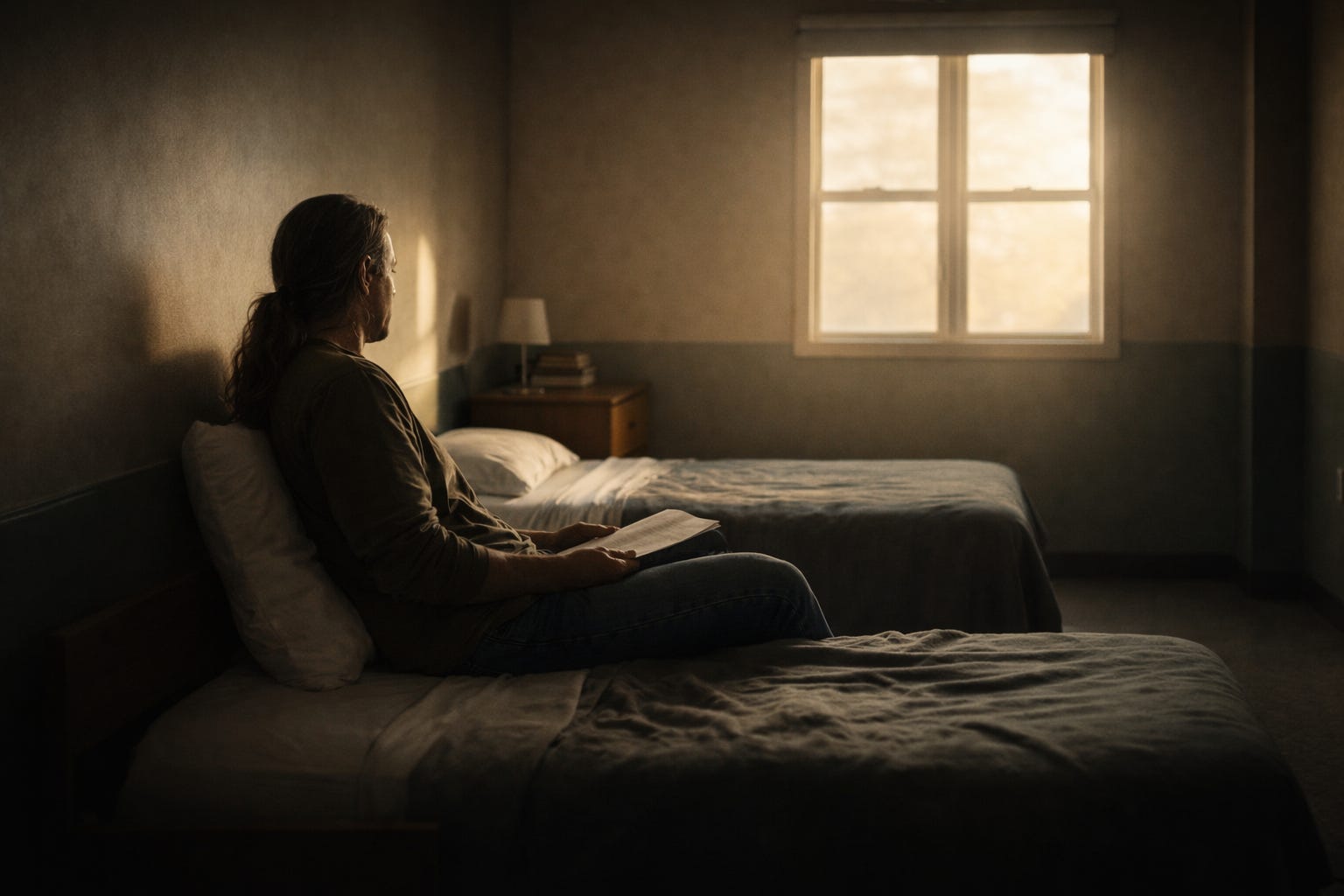
I was in my room, sitting on one of the twin beds, leaning back against the wall with my release paperwork on my lap. The rooms were designed for two—two beds, a little common area, a closet. Simple. Clean. Nothing fancy. But that day the room felt like a crossroads.
Because the paperwork wasn’t just paperwork. It was my sobriety plan. My plan to stay engaged enough that alcohol and prescription drugs wouldn’t be an option anymore.
And the part that made it real was that I had to present it.
Not just to my counselor, but on Zoom to my daughter, my brother, and my ex-wife. A thirty-year marriage. A long history. A lot of truth.
This was a group of people I could not fool.
Before I even got to the forms, something happened in that room that still feels strange in the best way. Call it synchronicity, or luck, or just a small world doing what it does. My roommate was exactly what I needed at exactly the moment I needed it.
We started talking the way people do in rehab when they’re finally too tired to keep pretending. And then I found out he was a colleague of my ex-wife.
On paper, that could’ve made things awkward. Instead, it made the room safer.
Because he already knew parts of my story—especially the story of my son. He didn’t know me completely, but he knew enough. Enough that I didn’t have to explain everything from scratch. Enough that I didn’t have to perform a cleaned-up version of myself. Enough that the room felt less like a place to hide and more like a place to tell the truth.
He became—and still is—a friend I can turn to, and he’ll be there. I hope I would do the same.
That was my first clue that recovery might not be something I do alone.
And I wasn’t doing it alone in another way either.
During that whole period I was talking with my girlfriend every day. Not in a dramatic way. Just steady. Honest. Present. By then we had decided we were going to do this together—back-to-back. If this was going to work, sobriety couldn’t be a private project. It had to be a shared decision.
So when I say I was sitting there with that paperwork on my lap, I wasn’t just writing a plan for myself. I was also holding a kind of relay baton.
Because the day I left, I went home, picked her up, and drove her to the same rehab facility I had just walked out of.
That’s a sentence I still have to read twice.
She was on the same journey. We were doing this together.
And we have.
We’re both sober, and we’re still together to this day.
So yes—there I was. Sitting on a twin bed at Northpoint. A counselor waiting. A Zoom screen full of people who knew my patterns. A roommate who made the room feel safe. A future that didn’t feel like a speech—more like a question mark.
And then the paperwork did what paperwork sometimes does.
It asked one small question that opened an old door.
GED
I wish I could remember the exact question on the form. I can’t. But I remember what it triggered, because it came out of nowhere and landed heavy.
GED.
That word wasn’t just a test. It was a history.
When I was young, I thought about getting my GED more times than I can count. I even tried. I bought some books. I studied with my aunt—she was a former teacher and she had this steady way of making hard things feel possible.
My aunt also gave me room and board whenever I needed it. It wasn’t even a question. I could just show up. Sometimes my older brother would be there. Sometimes my younger cousin who lived there. That house had a kind of safety in it that I didn’t always know how to receive, but I felt it.
But the GED wasn’t just studying. I had to go down to Idaho State University for books and testing.
And that part scared me more than I wanted to admit.
ISU felt like high school, but worse. Like it was full of people who belonged in a way I never did. I went once and quit. Not because I didn’t care. Not because I wasn’t capable. Because I was intimidated. Because I was afraid to be seen trying.
After that, I had what I thought was a better idea: vo-tech for auto mechanics. Signed up. Took the tool money. And I never went.
I didn’t plan it that way. I wasn’t sitting there plotting anything. I was just scared. And when I get scared, I disappear.
So when that GED question showed up on the release paperwork, it didn’t feel like a motivational poster.
It felt like an old ghost.
But it also felt like a chance to break a loop.
Because the real question under the question was this:
What can I do to stay engaged enough that alcohol and prescription drugs aren’t an option anymore?
And right after I thought “GED,” another thought jumped in behind it—fast, almost practical:
If I can do that… why not college?
The Wild Idea
It wasn’t a dream. It wasn’t a plan. It didn’t come with confidence.
It was more like self-defense.
Because I knew one thing about myself: there’s no way I can go to college and be drunk at the same time.
So I wrote it down.
And then I had to say it out loud—to my counselor, and to a Zoom room full of people who knew exactly how easy it is for me to talk big and disappear later.
That’s when it became real.
Not because everybody clapped. Not because anybody said the perfect line. But because the plan left my head and entered the world.
And once it’s in the world, you have to live up to it in small ways—one day at a time.
That’s how I’ve learned most of my life works now. Not in breakthroughs. In repetitions.
Show up. Do the next right thing. Don’t disappear.
And slowly, things change.
The First Classroom
My first classroom moment wasn’t some triumphant comeback scene.
I remember walking in and realizing that I was the oldest student in the room. It’s funny now. I’m obviously the odd guy in the room, for lack of a better term, and I know it.
I’m not the brightest student in the class. My memory isn’t what it once was. And I have a speech problem—spasmodic dysphonia—that makes me hesitate. When I speak up, it’s only a few words, and sometimes they come out broken.
But here’s the part that still surprises me:
I feel safe in class now.
I don’t feel like I’m back in the old story where school is something to endure and escape. I don’t feel like I’m waiting for somebody to catch me being stupid. I actually look forward to going.
That doesn’t mean it’s easy. It just means it’s different.
And that difference matters more than I can explain.
Because what I needed wasn’t a new identity. I needed a place to practice living in the open again.
Learning How to Learn
One thing I’ve learned as an older student is that the body counts.
You can be excited about the semester and still underestimate what it costs to keep showing up—especially when you’re coming off rehab, surgery, and a life that has already asked more of you than you think you can carry.
Sometimes learning means knowing when to let something go. Dropping a class. Adjusting the plan. Telling the truth about what’s possible right now instead of forcing a version of yourself that looks good on paper.
I used to treat any adjustment like failure.
Now I’m trying to treat it like wisdom.
And I’m learning small strategies. Little tools. Ways to keep moving forward even when my brain doesn’t want to cooperate. Ways to stay engaged.
I’m not trying to be perfect.
I’m trying not to disappear.
A Bridge I Didn’t Expect
I also found help in places I didn’t expect.
There were times—late at night, overwhelmed, behind, unsure—when I didn’t want to email a professor with what felt like a stupid question. Old habits die hard.
So I asked ChatGPT instead.
Not to cheat. Not to fake my way through. Just to get unstuck. To turn confusion into a few clear next steps. To keep moving.
It became a bridge for me—between confusion and clarity, between old fear and new effort.
But the bigger bridge wasn’t a tool.
It was people.
My advisor. A professor who treated me like I belonged. My girlfriend. My daughter. My son. Even my roommate at Northpoint—one more proof that sometimes the right person shows up at the right time.
Between them, I found balance. A map and a mirror.
And I kept going.
Today
And then the past showed up again—public this time.
Just weeks ago the docuseries was released. I watched it once when it first came out. But I haven’t stopped feeling it since. The viewing ended, and the memories didn’t.
I disappeared for two weeks.
Not in a dramatic way. In the quiet way.
I stayed home with my girlfriend. I visited my daughter. And I worked through it with my son each week during our visits.
Those visits have been regular for a long time. And often they’re also when drama enters his life. Prison has a way of making everything more intense. Everything is smaller, louder, sharper.
And it’s never just Brian and me.
Brian’s mom—my ex—has been there. Sometimes my daughter too. We are still together in that way. It’s not a simple family story, but it’s a real one. We all have our own lives now. New partners. New routines. But when it comes to Brian, we show up. That part hasn’t changed.
And when we’re together, it isn’t just a ride down memory lane. We talk about our lives as they are today. Work. Health. Relationships. The ordinary stuff that keeps going, even when the big stuff refuses to stay buried.
Then it’s time to hug my son and walk out through the prison gates again.
Another docuseries. Another day. Same walk.
What drained me wasn’t only sadness. It was the strange violence of watching something private become public. Those vivid memories that never leave you were suddenly out in the open. I literally watched a docuseries about my life.
And as I watched, I noticed something about myself that I’ve felt for years but rarely name: I watched it like a witness. Not like a participant. I’ve always had that sense, especially during the hardest parts of my life, that I’m watching a movie of someone else’s story.
Only this time it wasn’t a metaphor.
It was a screen.
After that, I couldn’t climb back into my normal rhythm. I’m behind on schoolwork. I’m trying to drag myself out of what feels like depression, or burnout, or some mix of the two. I don’t have the words yet. I just know I’m not myself. My mind feels tired in a way that sleep doesn’t fix.
I dropped another class. Not because I stopped caring, and not because I’m giving up. I looked at the hole I was in after those two weeks and I knew I couldn’t get caught up without breaking something. So I pushed the credits to a couple weekend courses later in the semester. And I’m starting a new second-half class in the Honors College program.
It’s too much right now.
It just is.
But I also know this: I’ve started over before.
Recovery has never been one clean turning point for me. It’s been a series of returns.
Tomorrow
This is why the wild idea of college mattered in the first place. I didn’t choose it because life got easier. I chose it because life was going to keep coming—docuseries or no docuseries—and I needed something that would pull me back into the world when the past tried to swallow me whole.
So tonight I’m not going to force a big lesson out of this. I’m just going to tell the truth about where I am.
Tomorrow, I will get up and start again.
Series Ending
When I look back across these chapters, the path feels both clearer and more complicated than I ever imagined. School was my first trauma. Years later came the day my world collapsed. What followed wasn’t a dramatic comeback, but a long and uneven process of recovery—one honest step at a time, usually with the help of other people. Rehab, family, friends, classrooms, and small moments of courage slowly pulled me back into the world.
I’m still building a life now, and like most lives worth living, it’s unfinished.
One day, if Brian feels it might help him or someone else, he may choose to share his own story here in his own words. That will always be his decision.
As for me, I’ll probably return to writing the same way I came back to school—quietly, when something inside me says it’s time. Until then, I’ll keep doing the simple work that got me this far.
Showing up. Staying connected. Starting again when I need to.
Author’s Note
This series began as an attempt to make sense of a few turning points in my life. What I didn’t expect was how many people would recognize pieces of their own stories in these pages. Writing these chapters has been both difficult and unexpectedly healing.
Some parts of this series were shaped in conversation with ChatGPT. Not to replace my voice, but to help organize memories, test ideas, and find clearer ways to express what I was already trying to say. The experiences, reflections, and mistakes described here are my own.
If this story resonates with you, I hope it serves as a reminder that starting over rarely happens all at once. Most of the time it begins quietly—with a conversation, a question, or a small decision to keep showing up.
Thank you for reading.
Thanks for writing this. I’ve used it in my efforts to assure Matthew that no, he’s not “too old” to continue his education. Your son is very special to our family: so bright, so talented, so empathetic.
Hello Kerry. Blast from the past. Pam Weiss here formerly Hooyman. Thanks for posting on LinkedIn which led me here. I’ve been hearing about Substack and now joined. Sending thoughts of peace and hope. Memories of so many trade show hours.
Retired and loving it. Pam