

It does not feel like that long ago that I gave my son and daughter puppies for Christmas.
I can still picture it. The excitement. The little chaos. The kind of family memory that seems ordinary when it is happening, then years later becomes one of those markers you use to measure time.
And then somehow, last year, I found myself sitting in a statistics class with my daughter.
Yes, time flies.
But sometimes it does more than fly. Sometimes it folds back on itself and hands you a surprise.
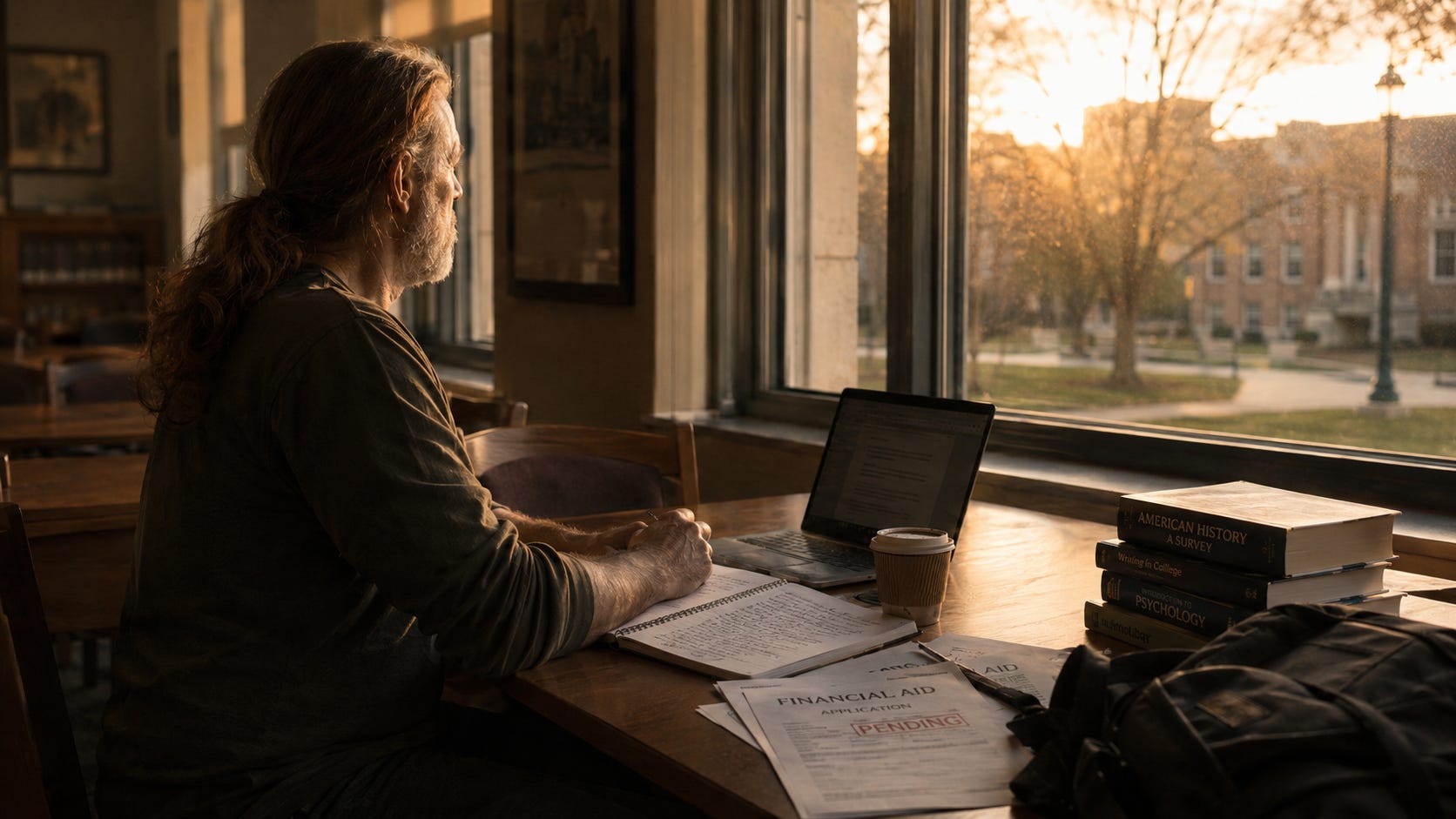
One day you are the dad giving the kids puppies. Another day you are a 60-year-old college student, sitting in class with your daughter, trying to remember formulas, due dates, Canvas announcements, and where you put your reading glasses.
That is one of the strange things about starting over later in life. It does not feel like a clean beginning. It feels like walking into a new chapter while all the old chapters are still in your backpack.
People sometimes talk about going back to school later in life as if it is one big inspirational comeback story. There is truth in that, I suppose. I am proud to be here. I am grateful to be here. But the truth is a little messier than that.
College at 60 is challenging every day.
Not always in dramatic ways. Most days are not dramatic at all. Most days are just ordinary hard.
The biggest hurdle I face is inertia.
That is the word that keeps coming to mind.
Not laziness. Not lack of interest. Not lack of caring. I care deeply. For the most part, I love the assignments. Not all of them, of course. I am still human. But I love learning. I love being in class. Most of the time, I look forward to going.
My classmates have been great with me. I have had very little trouble working with others. It happens sometimes, but overall I have been treated with kindness and respect. That still surprises me in the best way.
The hard part is often getting enough energy built up to begin.
Much of the time, I am fending off something. Depression, burnout, exhaustion, inertia. I am not always sure what to call it. I just know the feeling. My brain wants to learn, but my body and nervous system do not always get the memo.
There is another part of this story I do not talk about much.
Money.
It is hard to talk about, but it is a big part of the reality of school for me.
Before I checked into rehab, I received notice that my job was ending after a transition period. The company I worked for had been acquired by a much larger company, and the ERP system I had been administering was being eliminated. I helped facilitate the transition before rehab and again after I returned.
So the same season of my life included rehab, sobriety planning, the end of a job, the end of a career structure I had known, and the strange new idea that maybe I could finally get my GED and go to college.
I earned my GED and enrolled in college before my employment officially ended.
That still feels wild to write.
I had enough in savings to survive for about a year. Beyond that, I had to learn an entirely different system: financial aid, Pell Grants, scholarships, work-study, special circumstances appeals, and all the forms and deadlines that come with them.
By luck, and by timing, I was accepted into the Honors College on day one at my community college. I later learned it was the first year of that Honors program, and not many students had applied. I do not know exactly how to measure luck, grace, timing, and effort in a situation like that, but I know all of them were involved.
I kept my grades up and stayed in Honors after that. When I transferred schools, I had to apply again, and I was accepted again. That scholarship has helped tremendously.
So have Pell Grants.
So has work-study.
But none of it is simple.
I have had to complete special circumstances appeals to make sure my financial aid reflects my actual situation. One thing I learned the hard way is that taking money from a dwindling retirement account can count as income against Pell Grant eligibility. So even the act of trying to survive financially can create problems in the system designed to help you survive financially.
That is a strange kind of math.
Work-study has also been a blessing, but it is still work. I have been lucky to have great supervisors who have been flexible and patient with me. Much of the work I do is research and writing, which fits me well. I like it. I care about it. I have learned a lot from it.
But I also do it because I need the money.
That is an honest sentence.
And the time commitment is real. Research and writing can take me a long time, especially if I want to do it well. Estimating how long something will take is one of the things I am admittedly horrible at. I can think something will take a few hours and then realize I am still working on it days later.
So when I say college is challenging at 60, I do not only mean the assignments.
I mean the whole system around the assignments.
The financial aid forms. The scholarship applications. The work-study hours. The grants. The appeals. The worry about how many credits I can carry. The worry about what happens if I drop a class. The worry about how much energy I have left after doing the work that helps pay for the chance to keep doing the schoolwork.
Starting over at 60 is not just emotional.
It is logistical.
It is a thousand small calculations, and most of them happen quietly.
That is one of the things college has taught me at this age.
Learning is not just intellectual.
It is physical.
It takes energy. It takes memory. It takes emotional regulation. It takes the ability to shift gears. It takes the ability to sit in a room, track instructions, ignore noise, manage anxiety, remember what was just said, spell words under pressure, and produce something before the clock runs out.
Some people make that look easy.
For me, it can be exhausting.
I have limitations. Over time, I have learned to manage them better. But things can still go south.
Age has taken a toll on me. Addiction took a toll on me too. Recovery has given me my life back, but it did not give me a brand-new brain. Education has put a spotlight on my working memory in ways I did not fully expect.
In-person work that requires memorization and time constraints is especially hard. It requires repetitive preparation, and that preparation is time-consuming and highly dependent on energy. I have dropped two classes so far that had those kinds of constraints.
I did pass one class with a B where that kind of performance was required. It was Philosophy of Mind, which helped because I had a deep personal interest in the topic. Interest matters. When I care about something, I can sometimes hold onto it in a different way.
But even then, I had to work for it.
The old school challenges do not simply disappear because you are older.
Sometimes they just put on nicer clothes and show up again.
One of those old challenges is the spotlight.
I often freeze when I am under it.
That was true when I was young. One of the reasons I dropped out of high school for the last time was speech class. When it was time to give the speech, I simply refused to go. In my mind, I could not do it.
The spotlight was more than I could take.
That is why my first college speech mattered so much.
I gave it months after earning my GED in June 2022, at 57 years old. By luck, and honestly by blessing, I was in a very small Honors class. Only four students. We got to know each other, which made the first speech a little easier.
Not easy.
Just possible.
The first speech was short. A basic introduction, maybe a minute or so. I shook most of the time. I had a couple of small misses. But I finished.
That may not sound like much, but for me it was huge.
I did it.
By the end of that class, after my last speech, someone said that I did not shake. It was said in front of the class, but it was okay. She knew I would be okay hearing it there, and she was right.
That little comment meant more than she probably knew.
It was not some movie scene where I suddenly became fearless. I did not. But something had changed. Or maybe I had practiced enough for my body to believe, at least for a few minutes, that I might survive being seen.
That is the odd part about me.
I can speak to a group of people when I am the expert on the topic.
In fact, there was a time in my career when I gave software presentations as part of my job as an ERP application consultant. I would get pulled from consulting work for a couple of days to help with sales demonstrations. These were often multi-million-dollar deals, and I was a big part of the presentation.
The rooms might have six people or thirty people. Executives. Managers. Technical staff. Decision-makers. People with real money on the line.
And I was good at it.
I do not say that to brag. I say it because it matters to the point I am trying to make.
I was good because I knew the software. I had lived inside it in one form or another since the 1990s. I understood the business side and the technical side. I knew where the system was strong, and I knew where it was not.
I was also honest.
If a prospect asked, “Does your software do X?” and it did not, I would say no. I might have alternatives. Often I did. But if I mentioned one, it was real. It was tested. It was not smoke and mirrors.
In those rooms, I had my laptop connected to a projector. I had prepared like crazy. I knew the likely questions. I knew the demo path. I knew the system.
I was in control.
That made all the difference.
So it is not as simple as saying I cannot speak in front of people.
I can.
But I need structure. I need preparation. I need clarity. I need enough repetition that the task becomes familiar. I need the ground under my feet to stop moving.
That is where some classroom settings become difficult.
When group work is required, especially surprise in-class group work, I can struggle. I do not mean long-term group projects where we have time to clarify roles and expectations. I mean the kind where the professor says, “Break into groups and discuss this, then present your answer to the class.”
For many students, that is probably a nice break in the lecture.
For me, it can become a small storm.
I have to understand the assignment. If I do not understand it, or if the directions are unclear, and the group cannot agree on what we are supposed to do, I get lost. Other students often continue as if they know what they are doing. Sometimes they agree with each other. Sometimes they only sort of agree. I am trying to track all of that while the classroom is noisy, while other groups are talking, while the professor is clarifying something across the room, while my own group is still moving forward.
At that point, my focus can slip.
I lose the thread.
Then I am not only confused. I am confused under time pressure.
And when I am under pressure, my spelling gets worse. Much worse. I already do not spell well. I have spent a lifetime using technology to help me overcome that. Spell check, search, grammar tools, drafts, notes, time to revise. These are not luxuries for me. They are part of how I think and communicate.
When technology is limited, it can be disruptive.
I can write without it, but I am slow. Under pressure, I may freeze.
That is one of the tensions I am noticing in college right now.
For most of my life, I have been able to work at my own pace and in my own way. I am self-taught in many areas. I built a career in technology that way. I learned by doing, repeating, testing, breaking things, fixing things, and slowly turning confusion into competence.
School does not always work that way.
And now, with the rise of AI, some classroom constraints seem to be getting tighter. I understand why. I really do. Professors are trying to protect learning. They are trying to make sure students can think and write for themselves. That matters.
But there are ripple effects.
When the answer to AI is to move more work into timed, in-person settings with limited technology, some students lose more than convenience. They lose tools that help them participate.
For me, that scaffolding matters.
Another class I dropped used surprise in-person tests. During the first one, I was totally confused by the directions. It was a combination of multiple-choice and essay questions. We had fifteen minutes.
I looked at it and laughed to myself.
Not because it was funny, exactly.
Because I knew immediately that I would not complete it correctly in time.
So I guessed my way through much of it.
That feeling took me right back to school when I was younger. The same old panic. The same old sense that everyone else had received some instruction manual I never got.
Being 60 does not automatically erase that.
It just gives you more history to understand it.
The only thing I have found that really helps me with in-person exams and timed work is repetition. Lots of it.
I use AI to build study guides in formats that work well with text-to-speech. Then I listen to them over and over again while I walk or drive. I use AI to create short explainer videos for topics likely to be covered on a test. I listen. I watch. I repeat.
That repetition helps me visually and audibly.
It helps the material settle.
It is the same reason I could give those ERP presentations years ago. I was not fearless. I was prepared. I had repeated the material so many times that I could move through it even when people were watching me.
That is still true.
Repetition is how I survive the spotlight.
This summer, I am facing more in-person work that requires memorization and time constraints. It is exhausting. This time I do not even have spell check, so I am sometimes looking up words in a dictionary like I have been dropped into some strange academic survival challenge.
And yet, I am still here.
That is the part I do not want to lose sight of.
I am not writing this as a complaint. I am not saying every assignment should be redesigned around me. I am not saying professors have an easy job. They do not.
I am trying to describe what it actually feels like to start over at 60.
It feels like gratitude and exhaustion living in the same body.
It feels like loving class and still having to talk yourself into opening the laptop.
It feels like being proud of your progress and embarrassed by your limitations on the same day.
It feels like knowing you are capable, but also knowing capability depends on conditions.
It feels like discovering that some old wounds are still tender.
It feels like learning that financial aid is not just paperwork. It is part of survival.
It feels like realizing that the tools you use are not shortcuts. Sometimes they are bridges.
A bridge between confusion and clarity.
A bridge between fear and effort.
A bridge between disappearing and showing up.
That last one matters most to me.
Because for much of my life, when I got overwhelmed, I disappeared.
I dropped out. I avoided the speech. I did not show up. I found a way around the thing I was afraid of, even when going around it cost me more than facing it would have.
I understand that pattern better now.
I do not hate myself for it the way I used to.
But I also do not want to keep living by it.
That is part of why college matters to me. It gives me a place to practice showing up. Not perfectly. Not every time. Not without dropped classes or messy weeks or late assignments or days when inertia wins for a while.
But I keep returning.
I am writing this because I suspect I am not the only person trying to begin again with limits, bills, old fear, and a tired brain. Maybe your version looks nothing like college. Maybe it is a new job, recovery, grief, caregiving, disability, divorce, retirement, or just the quiet realization that the life you planned is not the life you are actually living.
Starting over does not always arrive with confidence.
Sometimes it arrives with paperwork, anxiety, a bus schedule, a half-finished assignment, and the need to rest before you can even begin.
At 60, starting over does not feel like becoming a brand-new person.
It feels like learning how to work with the person I actually am.
The person with a tired brain and a curious mind.
The person who still freezes sometimes.
The person who needs repetition.
The person who needs scholarships, grants, work-study, and a little luck.
The person who can stand in front of a room when the ground is steady enough.
The person who once avoided speech class and later gave a college speech while shaking.
The person who sat in statistics class with his daughter and thought, somehow, here we are.
The person who still loves learning, even when the starting is hard.
Maybe that is what starting over really looks like.
Not a clean break from the past.
Not a motivational poster.
Not one grand transformation.
Just another morning, another class, another form, another application, another assignment, another chance to build enough momentum to begin.
And maybe, at this age, that is enough.
Maybe it is more than enough.
Kerry: Terrific article and beautifully written. I hope a lot of people who have thought about going back to school, but haven’t yet a cause they think they’re “too old” and will somehow be out of place, read this and get just the encouragement they need. By the way, totally agree with you as to how much more difficult it is to memorize as time goes on. I’m 81; I’m committed to memorizing a new poem every year, but it takes longer now. Still, it gets done.